Why Tracking Changes Everything
Pregnancy is only possible during the fertile window: the five days before ovulation, the day of ovulation, and roughly a day after. Sperm survive up to five days; the egg lasts about 24 hours. Your best odds come from intercourse in the 1–2 days before ovulation — which means predicting it, not just spotting it after the fact.
Method 1: Calendar Tracking (Free, Start Here)
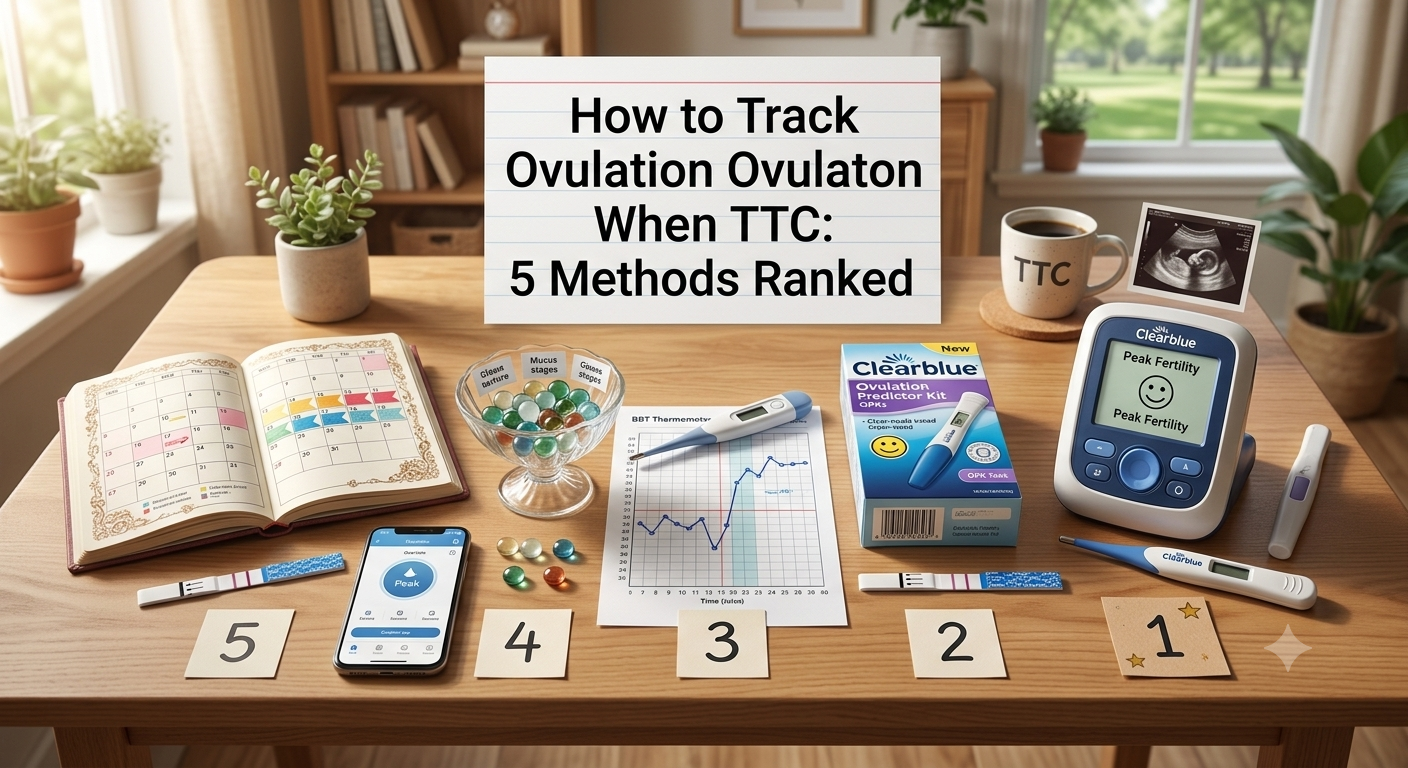
Mark day one of each period and count cycle lengths for several months. Ovulation typically happens 12–14 days before your next period starts — not on "day 14" unless you happen to have a textbook 28-day cycle. Best as a rough map; do not rely on it alone if your cycles vary.
Method 2: Cervical Mucus (Free, Surprisingly Accurate)
As ovulation approaches, discharge turns clear, slippery, and stretchy — like raw egg white. That is peak fertility, happening in real time. It costs nothing and tells you exactly when to prioritize trying.
Method 3: Basal Body Temperature (Cheap, Confirms After the Fact)
Take your temperature at the same time every morning before getting up. After ovulation, progesterone raises BBT by about 0.5–1.0°F, and it stays elevated. BBT cannot predict ovulation — it confirms it happened, which over 2–3 months reveals your personal pattern. Note: interrupted sleep (hello, newborns and night shifts) makes BBT noisy.
Method 4: Ovulation Predictor Kits (Most Bang for the Buck)
OPK strips detect the LH surge that occurs 24–36 hours before ovulation. Testing daily for five days around your expected ovulation catches it about 80% of the time; ten days of testing pushes that to ~95%. Strips are cheap in bulk — start testing a few days before your earliest predicted ovulation day.
Method 5: Apps and Wearables (Best for Irregular Cycles)
Cycle apps combine your logged data with algorithms; wearables add overnight temperature and heart-rate trends. They shine when cycles are irregular and manual prediction keeps missing. Treat their predictions as hypotheses to confirm with mucus or OPKs, not gospel.
The Power Combo
Most fertility specialists suggest pairing cervical mucus + OPKs for prediction, with BBT as monthly confirmation. Track all three in your Catalyst Mom dashboard, where our TTC pattern reports help you see your cycle trends over time.
When to Loop In a Professional
Under 35: after a year of well-timed trying. 35 or older: after six months. Sooner if your cycles are very irregular or absent — that is data worth investigating, not just working around. And while you are trying, our guide to evidence-based TTC tips covers the lifestyle side.
A Sample One-Cycle Tracking Routine
| Cycle phase | What to do |
|---|---|
| Day 1 (period starts) | Log it. This anchors every other calculation. |
| Days 1–7 | Take BBT each morning before getting up. Nothing else needed yet. |
| About 5 days before expected ovulation | Start daily OPK strips (same time each afternoon) and begin checking cervical mucus. |
| Positive OPK or egg-white mucus | This is the green light — prioritize the next 2–3 days. |
| 2–3 days after suspected ovulation | Look for the sustained BBT rise that confirms ovulation happened. |
| End of cycle | Review the month: did the OPK, mucus, and temperature shift agree? Each cycle sharpens next month's prediction. |
5 Common Tracking Mistakes
- Assuming day 14. Ovulation timing varies enormously; track your body, not a textbook cycle.
- Testing OPKs with morning urine. The LH surge often starts mid-morning — early afternoon testing catches it more reliably.
- Taking BBT after getting up. Even a trip to the bathroom first can distort the reading. Thermometer on the nightstand, reading before your feet hit the floor.
- Stopping intercourse after the positive OPK. The surge means ovulation is coming in 24–36 hours — the next two days still count, a lot.
- Switching methods every month. Each method needs 2–3 cycles of your own data before its predictions get sharp. Pick a combo and stay with it.
Ovulation Tracking FAQ
Can I ovulate without ever getting a positive OPK?
Yes. Some women have short LH surges that a once-a-day test misses. If your BBT shows a clear sustained rise but OPKs stay negative, trust the temperature pattern — or test twice daily around your expected surge.
Can I get pregnant outside the fertile window?
Conception requires an egg, so functionally no — but the window is wider than it feels because sperm survive up to five days. The practical takeaway: starting "too early" costs nothing; starting after ovulation usually misses the month.
How do I track with irregular cycles?
Lean on real-time signals (cervical mucus and OPKs) rather than calendar prediction, and give it more testing days. Persistently irregular or absent cycles deserve a medical conversation — they are the most common treatable cause of slow conception.
This article is for educational purposes only and is not medical advice. Always consult your healthcare provider before starting or changing any exercise, nutrition, or fertility plan.