What Diastasis Recti Actually Is
During pregnancy, the connective tissue between your "six-pack" muscles (the linea alba) stretches to make room for baby. For about 60% of moms, that separation — diastasis recti — persists after birth. The result: a soft belly that will not flatten, a doming ridge when you sit up, low-back pain, or a core that just feels disconnected.
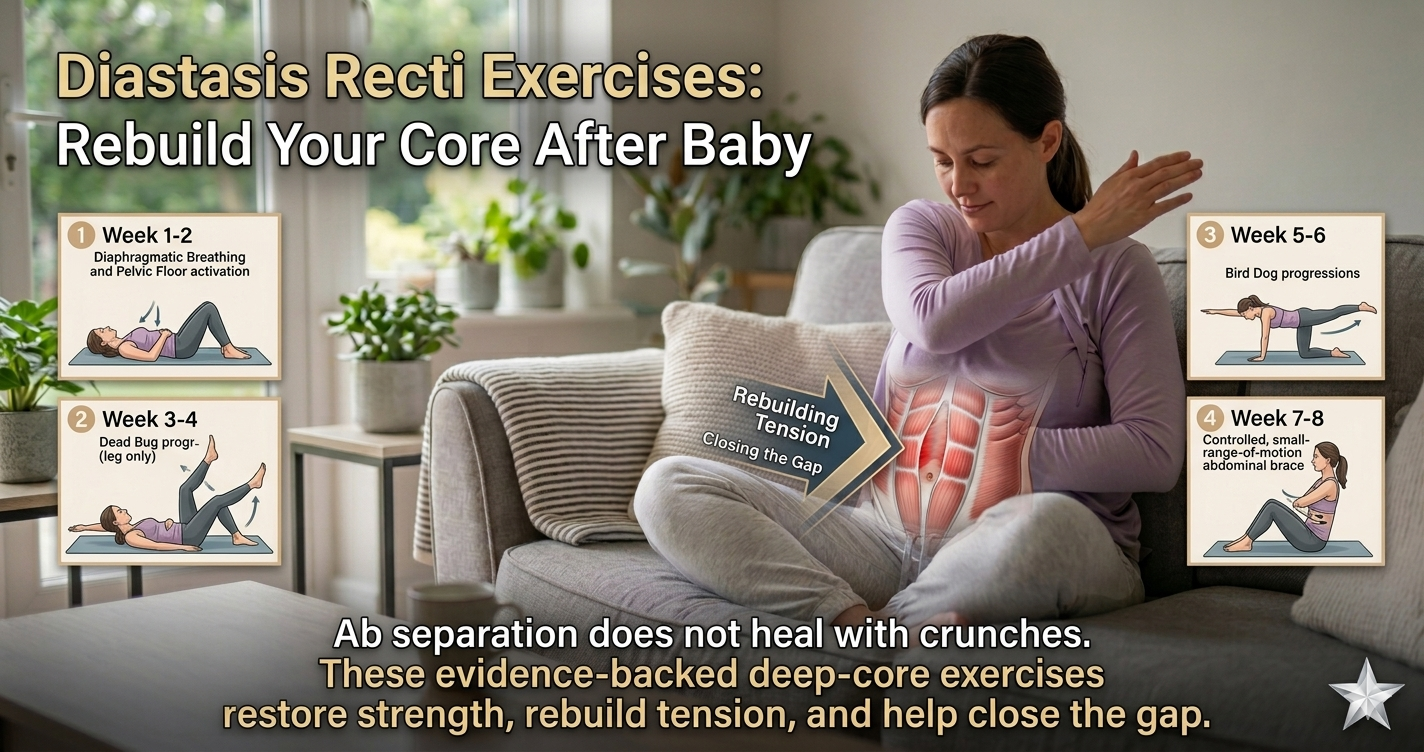
Here is the reframe that changes everything: healing is less about closing the gap and more about rebuilding tension across it with your deepest abdominal layer, the transverse abdominis (TVA).
First: Check Your Gap
Before starting, do a 60-second self-check (full instructions in our at-home diastasis test guide). Knowing your starting width and depth lets you track real progress.
The 5 Foundational Exercises
1. Diaphragmatic Breathing with TVA Engagement
Lie on your back, knees bent. Inhale into your ribs and belly. As you exhale, gently draw your belly button toward your spine — like hugging baby with your abs, not sucking in. Hold 5 seconds. 10 reps. This breath is the foundation of every other exercise.
2. Heel Slides
Same position. Exhale, engage your TVA, and slowly slide one heel along the floor until the leg is straight, then return. Alternate. 8–10 per side. The challenge: keep your core engaged so your back never arches.
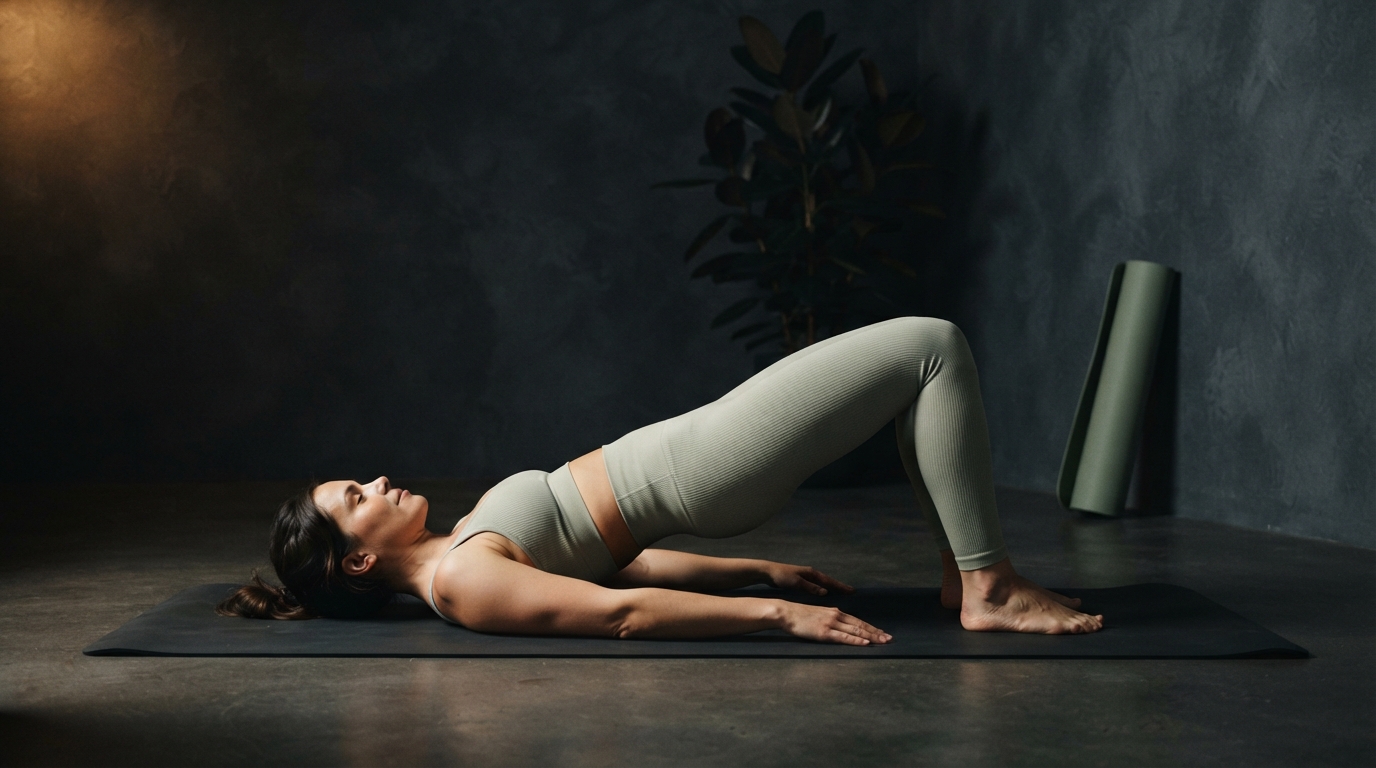
3. Glute Bridges
Exhale, engage, and lift your hips into a bridge. Hold 3 seconds, lower with control. 10–12 reps. Strong glutes take pressure off the healing midline.
4. Modified Side Plank
From your side with knees bent, lift your hips, keeping shoulder over elbow. Hold 10–15 seconds per side. Side work strengthens obliques without straining the linea alba.
5. Bird Dog
On hands and knees, exhale and extend opposite arm and leg while keeping hips level. Slow and controlled, 6–8 per side.
The Rules That Protect Your Healing
- No doming, ever. If your belly cones or ridges during a movement, the load is too much. Regress and rebuild.
- Exhale on effort. Holding your breath spikes intra-abdominal pressure right at the weakest point.
- Skip crunches, sit-ups, and front planks until tension is restored — see the full list of exercises to avoid.
- Consistency beats intensity. 10 focused minutes daily outperforms one hard weekly session.
Want a Structured Plan?
Our Core Restore Foundations program walks you through this exact progression week by week, with video coaching and built-in checkpoints. If you are more than 8 weeks postpartum and seeing no change, a pelvic floor physical therapist is worth every penny.
How Long Does Recovery Take?
With consistent daily work, most moms see meaningful change in 6–12 weeks: the gap narrows, the midline firms up, and everyday movements stop feeling unstable. Full return to high-impact exercise commonly takes 3–6 months. Two honest caveats: progress is rarely linear (hormones, sleep, and carrying a growing baby all tug at it), and a small, firm residual gap is completely compatible with a strong, pain-free core. Function beats centimeters.
Your First 4 Weeks: A Sample Progression
| Week | Daily focus (about 10 minutes) |
|---|---|
| 1 | Breathing with TVA engagement only — 3 sets of 10, morning and evening. Learn the exhale-engage pattern until it is automatic. |
| 2 | Add heel slides (8 per side) and glute bridges (10). Keep checking: no doming. |
| 3 | Add modified side planks (3 x 10 seconds per side). Increase bridge holds to 5 seconds. |
| 4 | Add bird dogs (6 per side). Re-test your gap and compare width and tension to week 0. |
From week 5 onward, progress one variable at a time — longer holds, more reps, then more challenging positions. The Core Restore Foundations program continues this progression through full strength training.
Beyond Exercise: Habits That Speed Healing
- Posture resets. Stack ribs over pelvis when standing and feeding. A rib cage flared toward the ceiling keeps constant stretch on the midline.
- Smart lifting mechanics. Bring baby (and car seat) close to your body, exhale as you lift, and avoid twisting mid-lift.
- Manage constipation. Straining is a direct pressure spike on the healing midline — fiber, water, and a footstool under your feet genuinely matter here. Our meal plan tool can build a fiber-forward week.
- Sleep and protein. Connective tissue rebuilds with collagen, and collagen needs protein and rest. Aim for protein at every meal.
Diastasis Recti FAQ
Can diastasis recti heal years after pregnancy?
Yes. The same deep-core retraining works whether you are 6 weeks or 6 years postpartum. Older diastasis often takes a little longer because compensation habits are ingrained, but the tissue still responds to progressive loading.
Will a waist trainer or binder fix it?
No. Compression garments can give comfort and gentle support in early postpartum, but they do not strengthen anything — and aggressive waist trainers can push pressure downward onto the pelvic floor. Use a soft wrap as scaffolding while you do the exercises, not instead of them.
Can I lift weights with diastasis recti?
Yes, with two rules: exhale and engage before every rep, and choose loads where you can keep a flat midline (no doming). Many moms get stronger throughout recovery — the lifts just get selected and scaled deliberately.
When should I see a pelvic floor physical therapist?
If your gap is wider than four fingers, feels deep and soft with no improvement after 6–8 weeks of consistent work, or you have pain, bulging, or leaking, book the appointment. One assessment usually pays for itself in months of better-targeted work.
This article is for educational purposes only and is not medical advice. Always consult your healthcare provider before starting or changing any exercise, nutrition, or fertility plan.